Your filler runs on its own. Someone still feeds it.
Ready-to-use tubs arrive on pallets, in boxes, in bags. Before the first nest reaches your filler, a person has depalletized the box, opened it, lifted out the bagged tub, stretched the bag and placed it on the infeed. Every tub, every shift.
It ties up two operators per shift in a task that adds nothing to the product. And it is the one step in an automated aseptic process where the result still depends on who is on shift.
MANUAL TODAY
Pallet
Boxes of bagged RTU tubs arrive on US or EU pallets.
MANUAL TODAY
Box
Depalletized, opened and emptied by hand.
MANUAL TODAY
Bagged tub
Lifted out, bag stretched and carried to the infeed by hand.
YOUR FILLER
Infeed
Where your filler takes over.
From pallet to filler in four steps.
01
Pallet infeed
Picked directly from the pallet. A box buffer keeps the flow running during pallet exchange. Boxes, lids and flaps go into a waste container inside the cell, nothing is carried out by hand.
02
Box opening and bagged tub removal
Ompi, BD, Schott and Nipro boxes opened, empty cartons folded automatically. The bagged tub is lifted from the box, its position detected, rotated if it arrives upside down.
03
Bag orientation, stretching and inspection
The bag is stretched and smoothed. Cameras check every stretch, and only tubs with a correctly stretched bag go on to your filler.
Handover to your filling machine
Placed at a defined position at your filling machine. No interface, no control integration.
Under wraps.
UNTIL INTERPHEX 2027 · APRIL 13 TO 15
THE DIFFERENCE
Every tub the same,
before it reaches
your filler.
A patent-pending stretching mechanism pulls the bag taut, so every tub reaches your filler in the same position. Nothing changes at your bag supplier.
Patent pending

As delivered
Bagged RTU tub, straight from the box. Single or double bag, by recipe.

Precisely stretched
A patent-pending stretching mechanism takes the slack out of the bag. Cameras check every stretch.

Handed over
Onto the existing infeed conveyor of your filler. Bag opening and tub removal stay where they are: in your filling machine.
Conventional tub handling systems do not offer bag stretching. Ours does.
Two zones. One cell.
Under wraps.
UNTIL INTERPHEX 2027 · APRIL 13 TO 15
Six configurations.
Seven layouts.
Free-standing on levelling feet · installed inside a maintenance window · own controller, safety controller and HMI · up to ISO 7
Built on the MicroFactory Ecosystem.
Every application runs on the same standardized modules. RoboTub SteriFill is one of them.
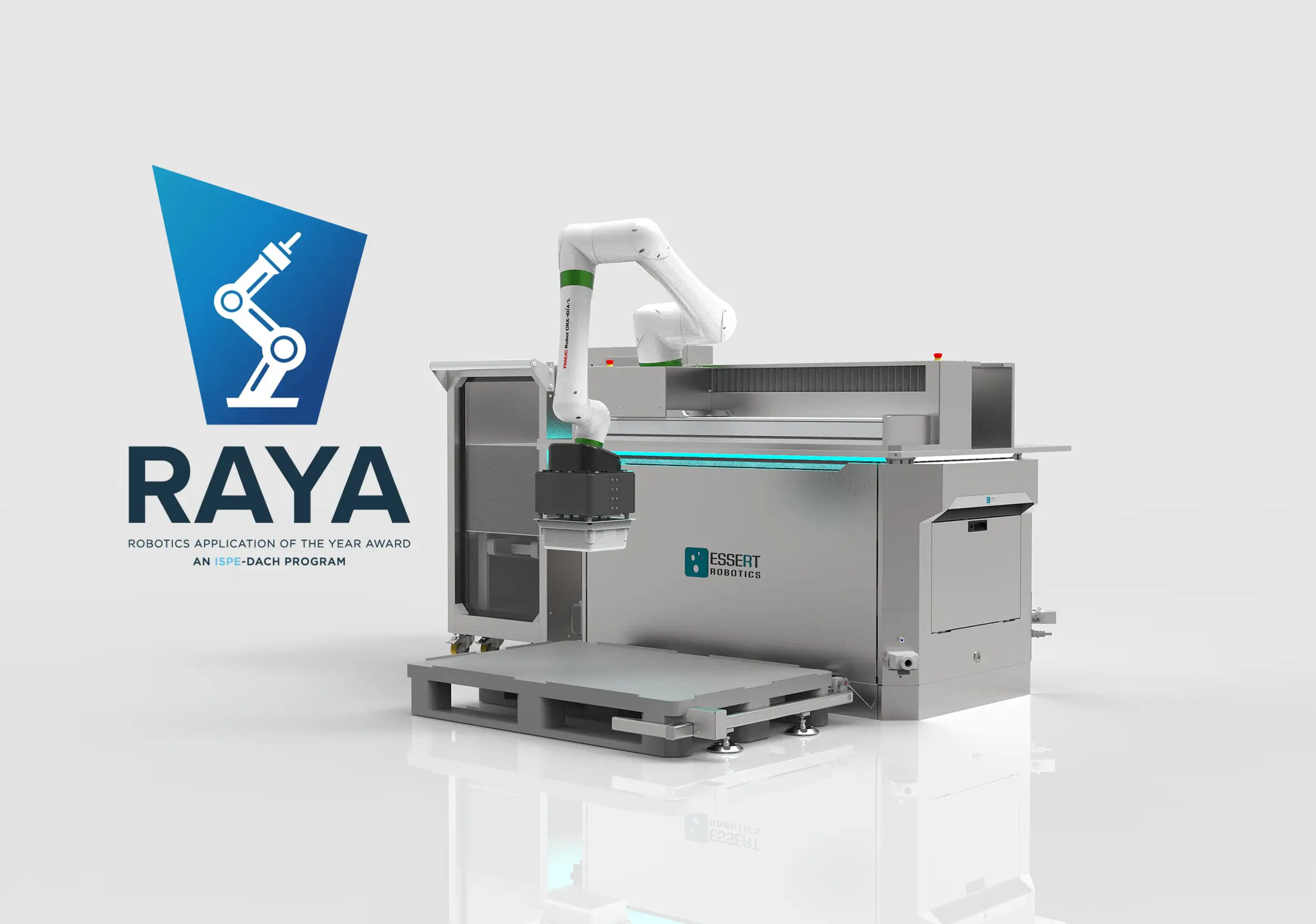
SINCE 2012 · 100+ MANUFACTURERS · ISPE ROBOTICS APPLICATION OF THE YEAR AWARD, 4 YEARS IN A ROW


Questions
we get asked.
What comes up in first calls, answered short.
The long answers we bring to the meeting.
Does RoboTub SteriFill open the bag?
No. The cell opens the box, lifts out the bagged tub, stretches the bag and hands the tub over. Bag opening and tub removal happen in your filling machine, as they do today.
Which RTU tubs does it handle?
2″ to 5″ tubs from Ompi, BD, Schott and Nipro, single and double bagged. Formats are selected by HMI recipe, without mechanical changeover.
Do I need to change my filling machine?
No. The cell places tubs onto your existing infeed conveyor and requires no changes to your machine controls or safety systems.
Which cleanroom class?
The cell is designed for cleanrooms up to ISO 7. Materials are assessed against three disinfectant classes common in these areas.
How is the cell qualified?
FAT with a simulated filler infeed, SAT on site. Risk assessment, SISTEMA calculation and the full documentation set arrive in English two weeks before FAT. A URS template is available.
What does the cell need on site?
A free-standing cell on levelling feet, without floor anchoring. Power and compressed air are standard industrial connections, the exact values come with your proposal.
What happens during pallet exchange?
Production continues. A built-in buffer keeps the cell running while the pallet is exchanged.