ASSEMBLING WHAT MATTERS
Device assembly.
Built to scale.
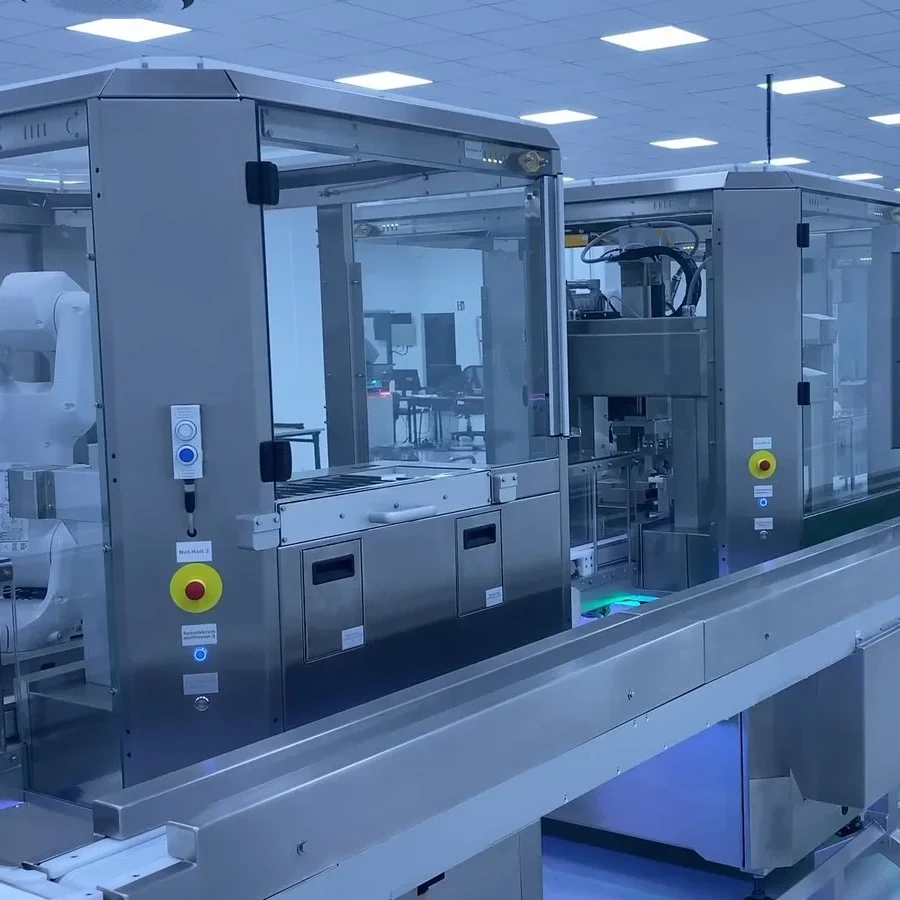
Robotic assembly modules for syringes, autoinjectors and combination products. From the first clinical batch to market supply, on the same platform.
THE PROBLEM
Your pipeline changes faster than your line.
Combination product assembly is every step between the filled primary container and the finished device: syringe into the autoinjector body, plunger rod, backstop, safety device, functional test, label, tray. Across variants. Across lifecycle stages.
Changeover is the rule, not the exception
Variants, formats, a new safety device, a second supplier: every change means format parts, line stops and a line clearance someone has to sign.
The pilot line can’t grow, the high-speed line can’t flex
Lines are sized once. Clinical batches are hundreds of devices, launch needs thousands, and the next product starts small again. Each stage tends to get its own machine.
Every extension puts the validated line at risk
Adding a module to a monolithic line means touching what is already qualified. The extension is small, the revalidation is not.

FOUR MOMENTS
Where we step in.
Whether you’re assembling the first clinical batch or scaling for launch: we bring the primary container and the device components together and take over the assembly, the testing and the labeling, down to the smallest patient-specific batches.
01
CLINICAL BATCHES
Hundreds of devices, not millions.
Lab-scale assembly with full traceability, on the platform you’ll scale on.
02
SYRINGE ASSEMBLY
Plunger rod, backstop, finger flange, label, tray.
Prefilled syringes assembled in a modular line. Add a safety device later without touching the validated core.
03
AUTOINJECTOR ASSEMBLY
Syringe meets device.
Feeding, joining, functional testing and labeling, with traceability per device: joining force, torque, vision.
04
WHEN THE PRODUCT CHANGES
New variant, next stage, one more module.
Syringes, autoinjectors and pens on one line, changed over by recipe in under 15 minutes. Extensions are qualified on their own.
Not sure which stage to start at?

THE OPTIONS
Three ways to run assembly.
A dedicated line
The changeover
format parts, a line stop, a line clearance to sign
The next stage
a new line for each volume
When something changes
re-engineer, revalidate the line
Manual workstations
The changeover
retrain, re-document
The next stage
more people, more stations
When something changes
traceability stays on paper
IN PRACTICE
What changes on the floor.
“
At Roche, we were looking for a modular, flexible solution for assembling different devices and found this solution in ESSERT’s MicroFactory Ecosystem.

Philip Schneider
Drug Product Manufacturing Network Technology Lead, Roche
MICROFACTORY ASSEMBLY LINE · ISPE ROBOTICS APPLICATION OF THE YEAR AWARD 2025 · TOGETHER WITH ROCHE
SOLUTIONS
Solutions for combination products.

Syringe Assembly
Plunger rod, backstop, finger flange and labeling on standardized modules. Add a safety device without touching the validated core.
View solution

Autoinjector Assembly
Pen-style and single-use autoinjectors on one platform, from development and clinical batches to market supply.
View solution

Semi-Automated Device Assembly
Device assembly from the first clinical batch to market supply on the same platform.
View solution

Flexible Batch Packaging
Top- and side-loading cartons for small batches and clinical trials, with changeover under 15 min.
View solution
Visual inspection of the filled container? ALVA. A Körber solution. Powered by ESSERT Robotics.
FAQ
Questions from everyone at the table.
Will it keep up when the product changes?
Changeover is software-driven: recipe and camera-based line clearance. The same line runs syringes, autoinjectors and pens and switches between them in under 15 minutes.
Can we start small and scale on the same platform?
Yes. Clinical batches run on the same modules as market supply. You add modules when demand grows, the qualified core stays.
What happens to validation when we add a module?
Each module is qualified on its own, tested at our commissioning station before it ships. Adding one means qualifying the new module, not revalidating the line.
What does traceability look like?
Per device: joining force, torque, visual inspection, documented on the module with audit trail. For lines, the Process Control Center brings it together.
Which devices and formats can you assemble?
Prefilled syringes with plunger rod, backstop and finger flange; single-use autoinjectors and pen-style injectors; combination products with an integrated safety device. Lab-scale cells for development and clinical batches.
Can the modules run in a cleanroom?
Yes. The GMP version in stainless steel is designed for cleanrooms up to ISO 7.
Do you inspect the filled syringe before assembly?
Visual inspection of syringes, vials and cartridges runs on ALVA, a Körber solution with robotic in- and outfeed automation by ESSERT Robotics.
Do you also pack the finished devices?
Yes. Flexible Batch Packaging packs devices and accessories into top- or side-loading cartons for small batches and clinical trials, with changeover in under 15 minutes between batches.
How do we find out whether this fits our product?
Tell us the device and the stage you're at. We come back with a first assessment, and if it makes sense, a concept and URS with you.
