What Is Robotic Tub Handling in Pharma Fill and Finish?

Ayhan Akyüz
•
Articles
What Is Robotic Tub Handling in Pharma Fill and Finish?
Ayhan Akyüz
•
Articles
What Is Robotic Tub Handling in Pharma Fill and Finish?
Ayhan Akyüz
•
Articles
Robotic tub handling is the automated loading, unloading, and transport of standardized tubs containing nested syringes, vials, or cartridges between pallets, boxes, and the filling, inspection, or packaging machine in pharmaceutical production. Robots take over the repetitive lifting, orienting, and placing steps that operators would otherwise perform by hand, thousands of times per shift.
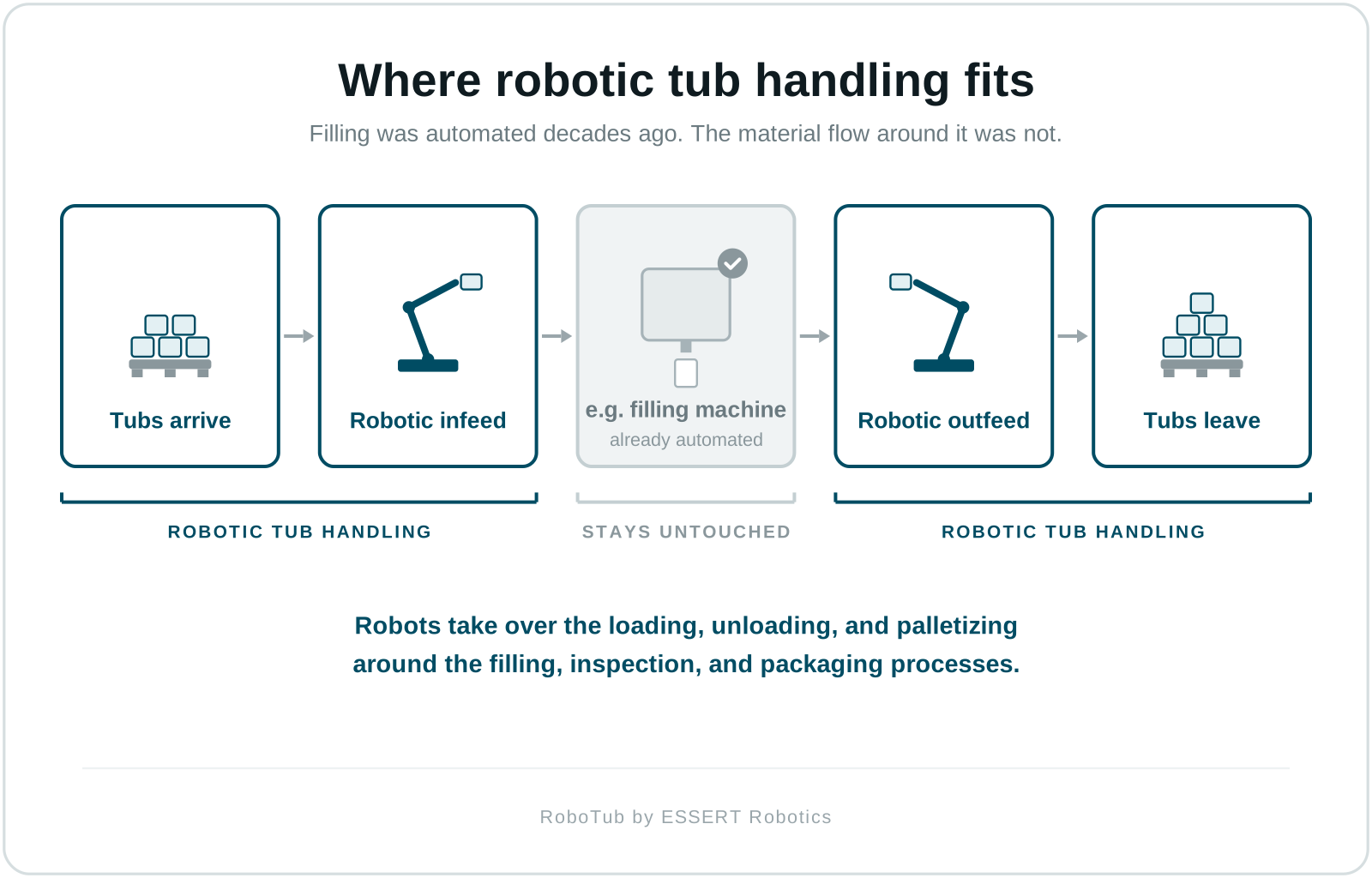
One boundary matters for the definition: tub handling does not fill anything. Most fill and finish lines already run on highly automated filling machines. The gap sits around them, where tubs still arrive on pallets or in boxes and get moved to the line manually. Robotic tub handling closes exactly that gap.
Why is tub handling still manual on so many lines?
Filling got automated decades ago because it touches the drug product directly. The material flow feeding it did not, because tubs arrive in too many configurations: different pallet formats, different box types, changing tub patterns. Rigid automation could not absorb that variety, so people did. The cost shows up in two places: contamination risk from human interventions near the line, and physical strain. According to the US Bureau of Labor Statistics, musculoskeletal disorders account for roughly a third of all worker injuries involving days away from work, and the National Academies have estimated their cost to US employers at up to $54 billion a year.
How does robotic tub handling work?
A typical robotic tub handling cell combines three functions:
Infeed: The robot picks tubs from the delivery medium. That can be a pallet (EU 48"x32" and US 48"x40" formats, 16 or 17 tub patterns), a Gaylord box, or another container. The delivery medium is a configuration choice, not part of the definition.
Orientation and transfer: A camera verifies tub position and orientation, then the robot places the tub onto the conveyor feeding the filling, inspection, or packaging machine.
Outfeed: After processing, the same principle runs in reverse: tubs come off the line and get palletized or packed.
Modern systems use collaborative robots and run autonomously around the clock. An operator starts the shift, then the cell runs on its own.
As Arno Schroff of VETTER Pharma puts it: "one single RoboTub module can reduce the number of operators down to 1. The system has already paid for itself after 1 year."
What throughput can robotic tub handling reach?
As a benchmark from our own platform: a single-robot cell handles 3 tubs per minute including pallet exchange, and a two-robot configuration reaches 6 tubs per minute with uninterrupted pallet exchange. Bidirectional transfer between tubs and Rondo trays runs at up to 200 parts per minute with SCARA robots.
What about sterile environments?
Tub unboxing in cleanrooms is its own discipline. Before a tub can reach the filling machine, its outer box has to be unloaded from the pallet, opened, folded, and disposed of, all without a person leaning over sterile components. Systems like RoboTub SteriFill automate that sequence in three steps (box unloading and waste handling, box opening and folding, feeding the filling machine) and handle Ompi and BD boxes on EU and US pallets with 8 to 10 minutes of autonomous buffer.
What are the benefits?
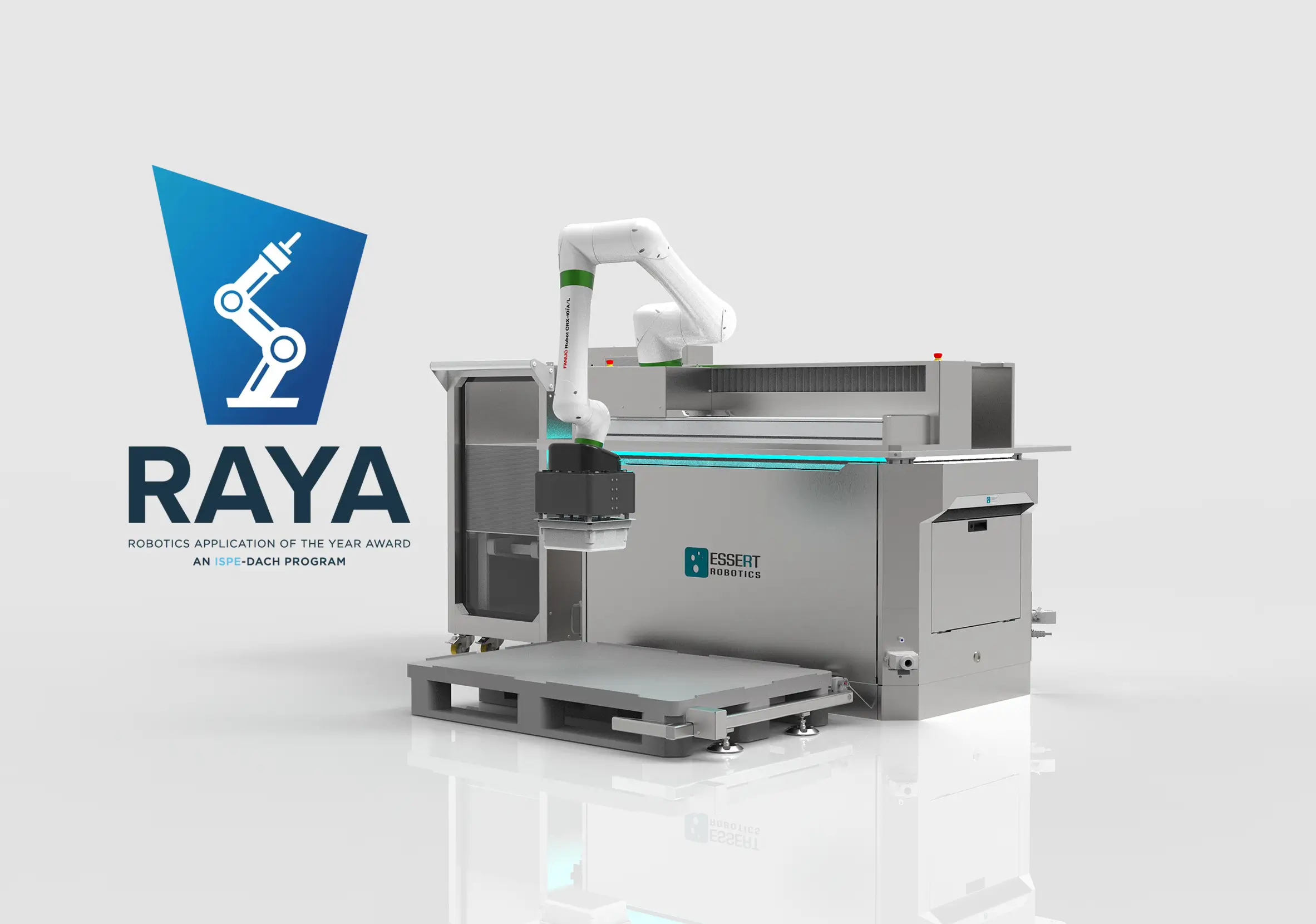
Fewer human interventions near the line means lower contamination risk and cleaner batch documentation. Operators move to supervision instead of repetitive lifting. And because modern cells are modular and GMP-compliant by design (the RoboTub platform carries the Robotics Application of the Year award from ISPE D/A/CH), they integrate without rebuilding the existing line.
Is robotic tub handling the same as automated filling?
No. Filling machines process the drug product. Tub handling automates the material flow around them: loading, unloading, unboxing, and palletizing. The filling machine stays untouched.
Which container formats can be handled?
Standardized tubs with nested syringes, vials, or cartridges. Dedicated vial handling cells cover formats from 2R to 30R.
Does it require a Gaylord box?
No. Gaylord boxes, pallets, and cases are configuration options. The core function is moving tubs between any delivery medium and the line.
Can it run in cleanrooms?
Yes. GMP-compliant stainless steel versions are approved up to ISO Class 5, and sterile unboxing systems exist specifically for aseptic environments.
How fast does it pay off?
VETTER Pharma reported that a single module paid for itself after one year.
Robotic tub handling is the automated loading, unloading, and transport of standardized tubs containing nested syringes, vials, or cartridges between pallets, boxes, and the filling, inspection, or packaging machine in pharmaceutical production. Robots take over the repetitive lifting, orienting, and placing steps that operators would otherwise perform by hand, thousands of times per shift.
One boundary matters for the definition: tub handling does not fill anything. Most fill and finish lines already run on highly automated filling machines. The gap sits around them, where tubs still arrive on pallets or in boxes and get moved to the line manually. Robotic tub handling closes exactly that gap.
Why is tub handling still manual on so many lines?
Filling got automated decades ago because it touches the drug product directly. The material flow feeding it did not, because tubs arrive in too many configurations: different pallet formats, different box types, changing tub patterns. Rigid automation could not absorb that variety, so people did. The cost shows up in two places: contamination risk from human interventions near the line, and physical strain. According to the US Bureau of Labor Statistics, musculoskeletal disorders account for roughly a third of all worker injuries involving days away from work, and the National Academies have estimated their cost to US employers at up to $54 billion a year.
How does robotic tub handling work?
A typical robotic tub handling cell combines three functions:
Infeed: The robot picks tubs from the delivery medium. That can be a pallet (EU 48"x32" and US 48"x40" formats, 16 or 17 tub patterns), a Gaylord box, or another container. The delivery medium is a configuration choice, not part of the definition.
Orientation and transfer: A camera verifies tub position and orientation, then the robot places the tub onto the conveyor feeding the filling, inspection, or packaging machine.
Outfeed: After processing, the same principle runs in reverse: tubs come off the line and get palletized or packed.
Modern systems use collaborative robots and run autonomously around the clock. An operator starts the shift, then the cell runs on its own.
As Arno Schroff of VETTER Pharma puts it: "one single RoboTub module can reduce the number of operators down to 1. The system has already paid for itself after 1 year."
What throughput can robotic tub handling reach?
As a benchmark from our own platform: a single-robot cell handles 3 tubs per minute including pallet exchange, and a two-robot configuration reaches 6 tubs per minute with uninterrupted pallet exchange. Bidirectional transfer between tubs and Rondo trays runs at up to 200 parts per minute with SCARA robots.
What about sterile environments?
Tub unboxing in cleanrooms is its own discipline. Before a tub can reach the filling machine, its outer box has to be unloaded from the pallet, opened, folded, and disposed of, all without a person leaning over sterile components. Systems like RoboTub SteriFill automate that sequence in three steps (box unloading and waste handling, box opening and folding, feeding the filling machine) and handle Ompi and BD boxes on EU and US pallets with 8 to 10 minutes of autonomous buffer.
What are the benefits?
Fewer human interventions near the line means lower contamination risk and cleaner batch documentation. Operators move to supervision instead of repetitive lifting. And because modern cells are modular and GMP-compliant by design (the RoboTub platform carries the Robotics Application of the Year award from ISPE D/A/CH), they integrate without rebuilding the existing line.
Is robotic tub handling the same as automated filling?
No. Filling machines process the drug product. Tub handling automates the material flow around them: loading, unloading, unboxing, and palletizing. The filling machine stays untouched.
Which container formats can be handled?
Standardized tubs with nested syringes, vials, or cartridges. Dedicated vial handling cells cover formats from 2R to 30R.
Does it require a Gaylord box?
No. Gaylord boxes, pallets, and cases are configuration options. The core function is moving tubs between any delivery medium and the line.
Can it run in cleanrooms?
Yes. GMP-compliant stainless steel versions are approved up to ISO Class 5, and sterile unboxing systems exist specifically for aseptic environments.
How fast does it pay off?
VETTER Pharma reported that a single module paid for itself after one year.
Robotic tub handling is the automated loading, unloading, and transport of standardized tubs containing nested syringes, vials, or cartridges between pallets, boxes, and the filling, inspection, or packaging machine in pharmaceutical production. Robots take over the repetitive lifting, orienting, and placing steps that operators would otherwise perform by hand, thousands of times per shift.
One boundary matters for the definition: tub handling does not fill anything. Most fill and finish lines already run on highly automated filling machines. The gap sits around them, where tubs still arrive on pallets or in boxes and get moved to the line manually. Robotic tub handling closes exactly that gap.
Why is tub handling still manual on so many lines?
Filling got automated decades ago because it touches the drug product directly. The material flow feeding it did not, because tubs arrive in too many configurations: different pallet formats, different box types, changing tub patterns. Rigid automation could not absorb that variety, so people did. The cost shows up in two places: contamination risk from human interventions near the line, and physical strain. According to the US Bureau of Labor Statistics, musculoskeletal disorders account for roughly a third of all worker injuries involving days away from work, and the National Academies have estimated their cost to US employers at up to $54 billion a year.
How does robotic tub handling work?
A typical robotic tub handling cell combines three functions:
Infeed: The robot picks tubs from the delivery medium. That can be a pallet (EU 48"x32" and US 48"x40" formats, 16 or 17 tub patterns), a Gaylord box, or another container. The delivery medium is a configuration choice, not part of the definition.
Orientation and transfer: A camera verifies tub position and orientation, then the robot places the tub onto the conveyor feeding the filling, inspection, or packaging machine.
Outfeed: After processing, the same principle runs in reverse: tubs come off the line and get palletized or packed.
Modern systems use collaborative robots and run autonomously around the clock. An operator starts the shift, then the cell runs on its own.
As Arno Schroff of VETTER Pharma puts it: "one single RoboTub module can reduce the number of operators down to 1. The system has already paid for itself after 1 year."
What throughput can robotic tub handling reach?
As a benchmark from our own platform: a single-robot cell handles 3 tubs per minute including pallet exchange, and a two-robot configuration reaches 6 tubs per minute with uninterrupted pallet exchange. Bidirectional transfer between tubs and Rondo trays runs at up to 200 parts per minute with SCARA robots.
What about sterile environments?
Tub unboxing in cleanrooms is its own discipline. Before a tub can reach the filling machine, its outer box has to be unloaded from the pallet, opened, folded, and disposed of, all without a person leaning over sterile components. Systems like RoboTub SteriFill automate that sequence in three steps (box unloading and waste handling, box opening and folding, feeding the filling machine) and handle Ompi and BD boxes on EU and US pallets with 8 to 10 minutes of autonomous buffer.
What are the benefits?
Fewer human interventions near the line means lower contamination risk and cleaner batch documentation. Operators move to supervision instead of repetitive lifting. And because modern cells are modular and GMP-compliant by design (the RoboTub platform carries the Robotics Application of the Year award from ISPE D/A/CH), they integrate without rebuilding the existing line.
Is robotic tub handling the same as automated filling?
No. Filling machines process the drug product. Tub handling automates the material flow around them: loading, unloading, unboxing, and palletizing. The filling machine stays untouched.
Which container formats can be handled?
Standardized tubs with nested syringes, vials, or cartridges. Dedicated vial handling cells cover formats from 2R to 30R.
Does it require a Gaylord box?
No. Gaylord boxes, pallets, and cases are configuration options. The core function is moving tubs between any delivery medium and the line.
Can it run in cleanrooms?
Yes. GMP-compliant stainless steel versions are approved up to ISO Class 5, and sterile unboxing systems exist specifically for aseptic environments.
How fast does it pay off?
VETTER Pharma reported that a single module paid for itself after one year.
Let’s Talk
Automation is a long-term commitment. We partner with manufacturers who think in lifecycles. If you are evaluating automation for a new product, scaling a process, or preparing for a future pipeline - let’s talk.
Let’s Talk
Automation is a long-term commitment. We partner with manufacturers who think in lifecycles. If you are evaluating automation for a new product, scaling a process, or preparing for a future pipeline - let’s talk.
Let’s Talk
Automation is a long-term commitment. We partner with manufacturers who think in lifecycles. If you are evaluating automation for a new product, scaling a process, or preparing for a future pipeline - let’s talk.
See what's new
Humanoid Robots in Pharma Manufacturing: What Is Hype, What Is Real
Pharma manufacturers keep asking about humanoid robots. A machine builder's assessment: safety standards, GMP qualification, precision, and what would need to change.
What Is Robotic Tub Handling in Pharma Fill and Finish?
What robotic tub handling is, how it works from infeed to palletizing, and why it closes the last manual gap in fill and finish.

What Is High-Mix Low-Volume (HMLV) Manufacturing in Pharma and MedTech?
Many products, small batches: what HMLV manufacturing is, why rigid lines fail under high mix, and what modular automation changes.
See what's new
Humanoid Robots in Pharma Manufacturing: What Is Hype, What Is Real
Pharma manufacturers keep asking about humanoid robots. A machine builder's assessment: safety standards, GMP qualification, precision, and what would need to change.
What Is Robotic Tub Handling in Pharma Fill and Finish?
What robotic tub handling is, how it works from infeed to palletizing, and why it closes the last manual gap in fill and finish.
What Is High-Mix Low-Volume (HMLV) Manufacturing in Pharma and MedTech?
Many products, small batches: what HMLV manufacturing is, why rigid lines fail under high mix, and what modular automation changes.
See what's new
Humanoid Robots in Pharma Manufacturing: What Is Hype, What Is Real
Pharma manufacturers keep asking about humanoid robots. A machine builder's assessment: safety standards, GMP qualification, precision, and what would need to change.
What Is Robotic Tub Handling in Pharma Fill and Finish?
What robotic tub handling is, how it works from infeed to palletizing, and why it closes the last manual gap in fill and finish.
What Is High-Mix Low-Volume (HMLV) Manufacturing in Pharma and MedTech?
Many products, small batches: what HMLV manufacturing is, why rigid lines fail under high mix, and what modular automation changes.
Contact our team
From initial questions to your custom MicroFactory solutions – our team is here to assist you.
Contact our team
From initial questions to your custom MicroFactory solutions – our team is here to assist you.
Contact our team
From initial questions to your custom MicroFactory solutions – our team is here to assist you.
