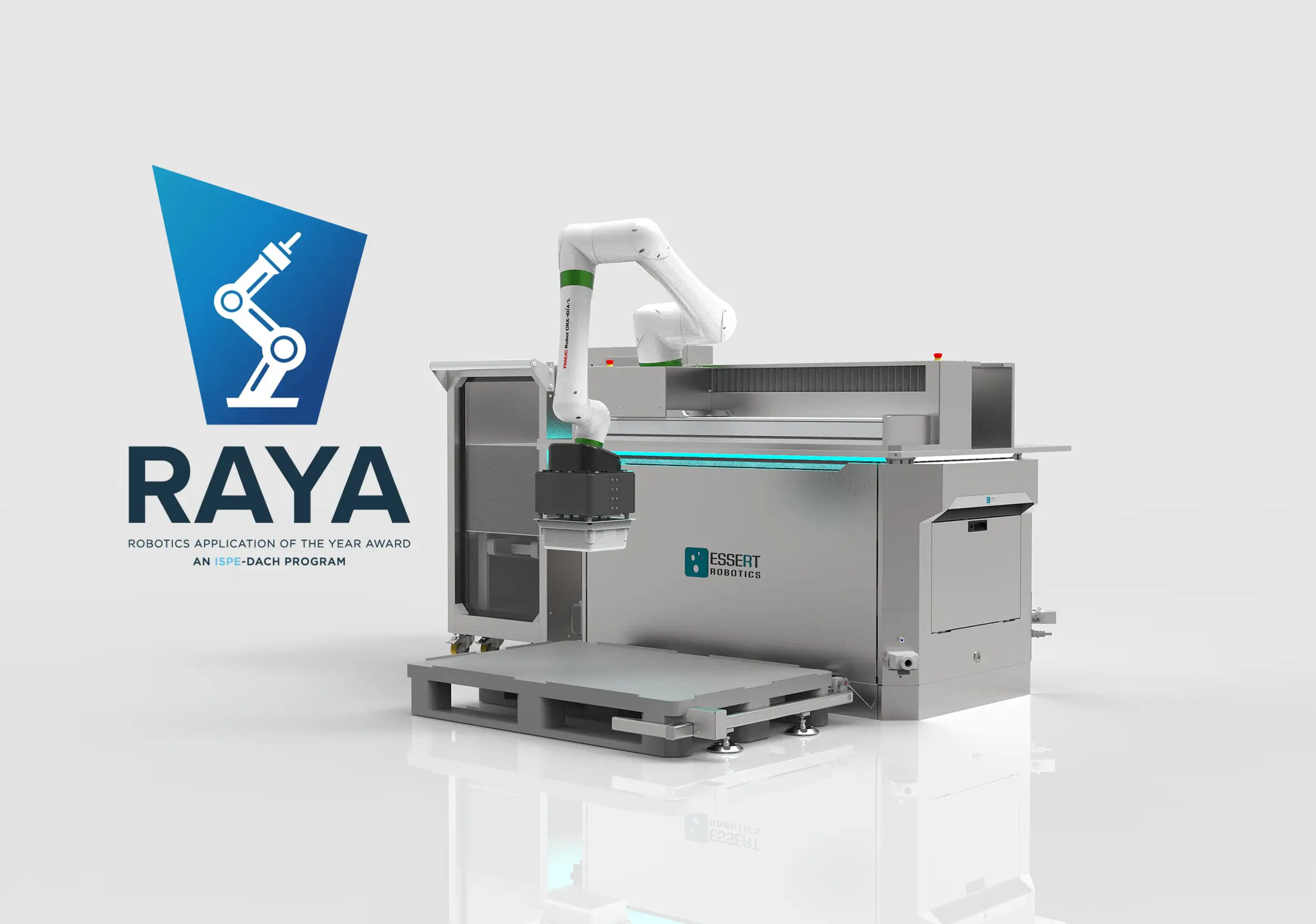
PACKING WHAT MATTERS
The cartons your people still pack.
Automated.
Automated packing for small batches and clinical trials. Changeovers in under 15 minutes, on a minimal footprint.

< 15 min
to change over, by recipe
1:1
one process, one module
Modular
acceptance test per module
HMLV
small batches and clinical trials
Small batches.
Big changeovers.
Every new product means new format parts and a changeover. For a small batch or a clinical trial, that rarely pays off, so it ends up packed by hand.
MANUAL TODAY
Erect
Carton folded open by hand.
MANUAL TODAY
Fill
Device, leaflet and accessories placed by hand.
MANUAL TODAY
Check
Contents and label checked by hand.
MANUAL TODAY
Close
Closed and labeled by hand.
From folding box to label.
One module per step.

PACKING
Folding box › Partition › Device › Accessories › Leaflet
Each step runs in its own module: cartons erected from flat blanks, partitions, devices from tubs or trays, vials, accessories and leaflets. Top and side loading cartons. A manual station can take over any step.
CLOSING AND LABELING
Check › Closing › Seal › Labeling
Every code is read and the contents are checked before the folding box is closed, sealed, printed and labeled.
New product?
Same line.

< 15 min
to change over.
A new product is a new recipe. The software sets the modules up, with no format parts to change within the validated range.

Each
module qualified on its own.
Each module can go through its own fully qualified acceptance test. All media run from module to module through hybrid connectors, which keeps installation simple.
Every carton knows
what’s inside.
In clinical supply, the right kit counts more than the fastest one. Every module reads what it handles, and the Process Control Center keeps one record per carton.
READ
Every code, every module.
Cameras and code readers check identity, presence and orientation before anything moves on.
LINK
One record per carton.
The Process Control Center links each carton to the devices, vials and leaflets inside it.
REJECT
Locked away.
A part that fails a check goes into a locked, sensor-verified reject drawer, not back into the flow.
IN THE BOX
What goes into the box.
Vials, syringes, autoinjectors, swabs, needles, wipes and leaflets, packed into various types of folding boxes and printed with any information, such as bar codes.

SHOWN: FOLDING, PACKING & PRINTING
As automated
as the batch needs.
One set of modules, three ways to start. Add modules when volumes grow, and the installed modules keep their qualification. The manual station runs on the same recipe and records at every level.
LEVEL 1
Manual-assist cell
Your team places the contents. The modules erect, check, close and record. Handles one-offs.
LEVEL 2
Hybrid cell
Infeeds for devices, cartons and leaflets join the cell. The operator replenishes and handles rejects.
LEVEL 3
Connected line
All modules in one line. Each job runs only the modules it needs.
Linear or cluster.
Built around your floor.
Arrange the modules in the formation that matches your production flow and logistics. The line fits into your existing infrastructure, without costly restructuring.

LINEAR
Modules in a line
PROCESS
One process per module
CARTONS
Top and side loading
CONTENTS
Devices, accessories, leaflets

CLUSTER
Modules in a cluster
LAYOUT
Any formation for your flow
MEDIA
Supplied from module to module
QUALIFICATION
Acceptance test per module
Carton, contents, batch sizes. We come back with a proposal within two working days.
Built on the MicroFactory Ecosystem.
One MicroFactory Core under every ESSERT module: standardized baseframe, interfaces, controller, safety and software. Flexible Batch Packaging runs on it, one module per process.
SINCE 2012 · 100+ MANUFACTURERS · ISPE ROBOTICS APPLICATION OF THE YEAR AWARD, 4 YEARS IN A ROW


FAQ
Questions
we get asked.
What comes up in first calls, answered short.
The long answers we bring to the meeting.
Which packs can it handle?
Folding cartons, top or side loading, with devices, vials, accessories and leaflets in different packaging configurations. We check your pack in the proposal.
How long does a changeover take?
Under 15 minutes. The software sets the modules to the new recipe while your team clears the line and brings the material.
What if a format is new to the line?
Within the validated range, a new format is a new recipe, set up on site. A new carton family or a much larger device means a new feeder or gripper configuration. A new process step is a new module, qualified on its own. One-offs run on the manual station, with the same records.
Is it made for clinical trials?
Yes. It is built for small batches and clinical trials, with a minimal footprint. One-offs can run on the manual station, with the same records.
How is the line qualified?
Module by module. Each module can go through its own fully qualified acceptance test.
Can the line fit our floor plan?
Yes. The modules can run in a line or in a cluster, in the formation that fits your production flow and logistics, without costly restructuring of your facility.
Can it print on the carton?
Yes. Any information, such as bar codes, can be printed, and labels are applied in the line.
Does it connect to our MES?
Yes. The Process Control Center connects to your MES via OPC UA and checks each order before release.