ASSEMBLING WHAT MATTERS
Autoinjector
assembly.
From clinical batches to market supply: feeding, marking, joining, closing, each step in its own module, force and path monitored.
15–30
parts per minute, depending on configuration
< 15
minutes to change between device formats
UP TO
ISO 7
cleanroom-ready modules
Full
traceability per device
WITH ROCHE
“At Roche, we were looking for a modular, flexible solution for assembling different devices and found this solution in ESSERT’s MicroFactory Ecosystem.”

Philip Schneider
Drug Product Manufacturing Network Technology Lead, Roche
2025
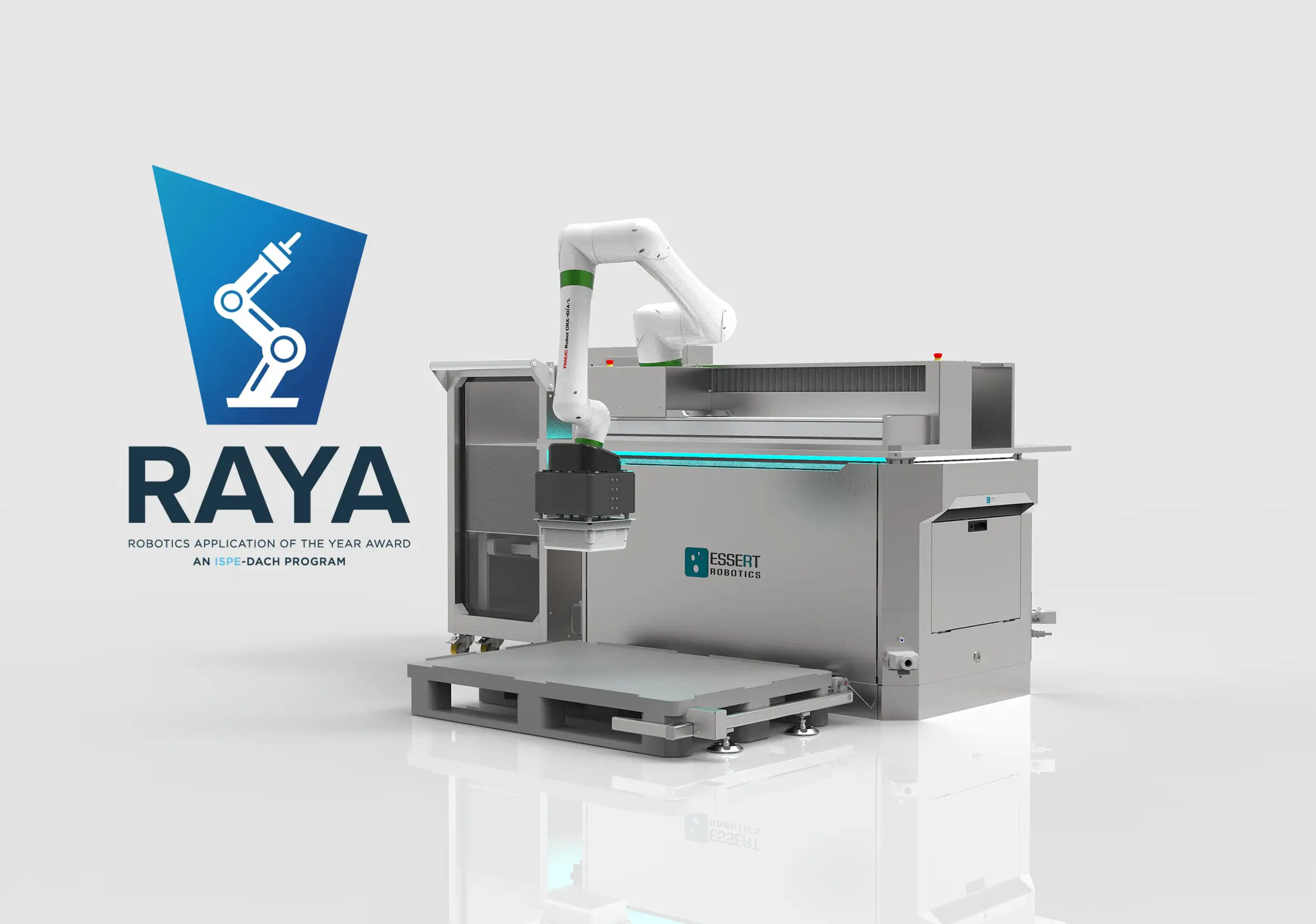
ISPE Robotics Application of the Year Award for the MicroFactory Assembly Line, together with Roche.
Best Innovative Technical Concept and Audience Award.
Your device evolves.
Your line has to keep up.
An autoinjector is part of the therapy. As the design evolves and production scales, a rigid, product-specific line turns every change into risk and a validation bottleneck.
CONVENTIONAL LINE
Design change
Every design iteration touches the whole line.
CONVENTIONAL LINE
Scale-up
Scaling up means a second line and full requalification.
CONVENTIONAL LINE
New inspection step
One added check puts the whole line back into validation.
CONVENTIONAL LINE
Format change
Mechanical format parts, the line stands still.
From tray to tray.
Every joint monitored.

FEEDING AND MARKING
Device feeding and disassembly › Laser marking › Syringe feeding
Each process runs in its own module:
Device feeding and disassembly
Laser marking with code verification
Syringe feeding from tub or Rondo tray
ASSEMBLY AND TRAY
Assembly › Tray loading
Force and path monitored at every joint:
Autoinjector assembly
Force monitoring
Tray loading
Design change?
Change one module.

One module
changes when the design changes.
Each critical step runs in its own module. A design change adapts the module it touches, so the impact stays local and change management stays simple.

Same line
from clinical batches to market supply.
You scale by adding modules with standardized interfaces. The modules that already run stay qualified, only the new ones are validated.
Conventional assembly lines are built for one product. A MicroFactory line runs syringes, autoinjectors and pens. Select a recipe, and in under 15 minutes the next batch runs: another syringe type or a different device altogether.

IN ACTION · 2:01
Autoinjector assembly at work.
A MicroFactory Assembly Line assembling pen injectors, from tray to tray.
SHOWN: MICROFACTORY ASSEMBLY LINE · PEN EXAMPLE
Two configurations.
One line that grows.
Start with the configuration that fits your device today and add modules as your product changes.

STANDARD
5 modules
PROCESSES
Device feeding to tray loading
MADE FOR
Clinical batches to market supply
MODULES
Pre-qualified, reusable for other products

WITH LABELING
6 modules
ADDED
A labeling module after assembly
CORE PROCESS
Stays as validated
VALIDATION
The new module only
SHOWN: ILLUSTRATIVE CONFIGURATIONS · ACTUAL LAYOUT DEPENDS ON YOUR DEVICE
Device, components, volumes. We come back with a proposal within two working days.
Built on the MicroFactory Ecosystem.
One MicroFactory Core under every ESSERT module: standardized baseframe, interfaces, controller, safety and software. Autoinjector Assembly runs on it, one module per process.
SINCE 2012 · 100+ MANUFACTURERS · ISPE ROBOTICS APPLICATION OF THE YEAR AWARD, 4 YEARS IN A ROW


FAQ
Questions
we get asked.
What comes up in first calls, answered short.
The long answers we bring to the meeting.
Which steps does the line cover?
The core functions are device feeding, primary assembly with joining and functional testing, and final labeling. Modules for functional testing, vision inspection of safety clips and serialization can be added.
What throughput does the line achieve?
15 to 30 parts per minute, depending on configuration. The line is built for high-mix, low-volume production, and throughput scales with the number of modules. Exact figures depend on device complexity and are confirmed in the feasibility phase.
How long does a format changeover take?
Under 15 minutes. Changeovers run on software recipes, and camera-based line clearance verifies them. For the highest output, format parts are added depending on configuration.
Is the line GMP-compliant?
Yes. It is designed for FDA and EU GMP and for cleanrooms up to ISO 7. Critical parameters such as joining force, visual inspection and torque are recorded per device for the audit trail.
How long is the delivery time?
Under 12 months. Modules are fully commissioned and tested before delivery, which keeps on-site ramp-up short.
How do we move from clinical batches to market supply?
By adding modules instead of replacing the line. New modules connect through standardized interfaces, the qualified modules stay unchanged, and only the new additions are validated.
Which devices does the platform assemble?
Pen-style injectors and single-use autoinjectors, including devices with an integrated safety device. The line is built around processes, so several device variants run on one line with recipe-based switching.
Does the same platform assemble syringes?
Yes. Syringe assembly runs on the same MicroFactory modules.