The Last Manual Bottleneck in Pharma Manufacturing
Filling and inspection run automated, the tubs and vials between them still move by hand. What that really costs, and what changes when the handling is automated.

Ayhan Akyüz
•
•
5 min read

The Last Manual Bottleneck in Pharma Manufacturing
Filling and inspection run automated, the tubs and vials between them still move by hand. What that really costs, and what changes when the handling is automated.
Ayhan Akyüz
•
•
5 min read
The Last Manual Bottleneck in Pharma Manufacturing
Filling and inspection run automated, the tubs and vials between them still move by hand. What that really costs, and what changes when the handling is automated.
Ayhan Akyüz
•
•
5 min read
The pharmaceutical industry has undergone a remarkable transformation. State-of-the-art filling machines operate with precision measured in microliters. Inspection systems detect defects invisible to the human eye. Yet in most facilities, there remains one persistent bottleneck: the manual handling of tubs and vials.
This seemingly minor aspect carries hidden costs that extend far beyond obvious inefficiencies. The repetitive lifting and positioning of containers represents not just a productivity challenge, but a significant health and safety risk affecting both human welfare and business performance.
According to the US Bureau of Labor Statistics, musculoskeletal disorders account for roughly a third of all worker injuries involving days away from work, and the National Academies have estimated their cost to US employers at up to $54 billion a year.
The True Cost of Manual Handling
The economic impact of manual tub and vial handling extends far beyond visible labor costs. While managers can calculate hourly wages, the comprehensive impact encompasses a complex web of hidden expenses.
Direct costs include:
Medical treatment and workers’ compensation claims
Specialized cleanroom rehabilitation requirements
Higher insurance premiums for facilities with poor safety records
Indirect costs often dwarf direct expenses:
Production disruptions when experienced operators are absent
Extensive training requirements for replacement personnel
Lost productivity from operator fatigue and reduced pace
Opportunity cost of deploying skilled technicians for manual tasks
The pharmaceutical industry’s emphasis on validated processes means temporary workers cannot simply replace experienced operators. New personnel require extensive training in GMP protocols, cleanroom procedures, and equipment operation before contributing meaningfully to production.
When skilled pharmaceutical technicians spend time on repetitive lifting, organizations forfeit the potential benefits of their expertise in process optimization, quality assurance, and continuous improvement initiatives.
Health Impact: More Than Just Numbers
Understanding the physiological impact requires examining both immediate biomechanical stresses and cumulative effects. A single tub looks manageable. The load comes from repetition: operators may handle hundreds of tubs in a single shift, creating cumulative loading that exceeds safe limits.
Cleanroom requirements create unique challenges. Gowning protocols often necessitate awkward postures, and contamination prevention means operators cannot always position themselves optimally for lifting. The precision required when placing tubs increases muscle tension and extends lifting cycle duration.
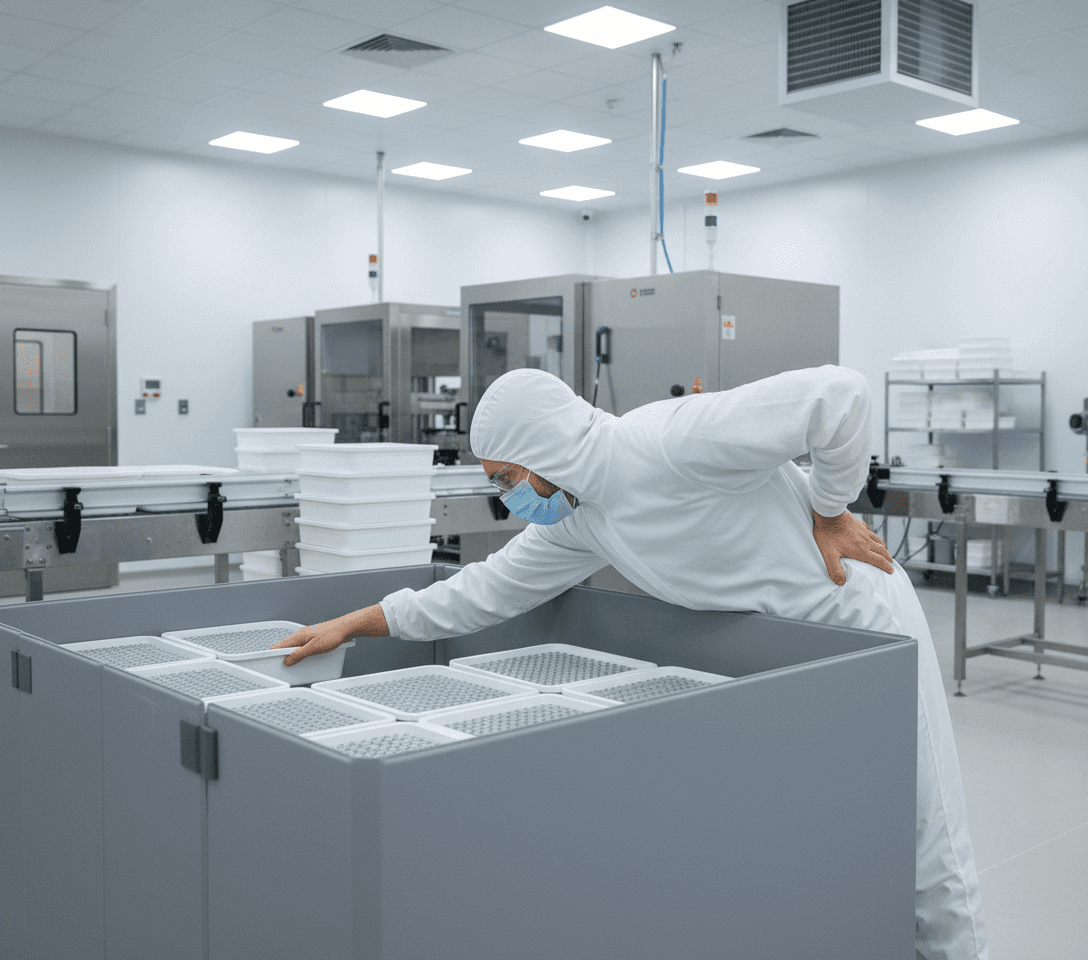
Key health concerns include:
Spinal loading from repeated lifting, twisting and reaching
Upper extremity disorders from sustained grip strength requirements
Fatigue accumulation increasing injury risk throughout shifts
Psychological stress from chronic pain affecting cognitive performance
The RoboTub Solution: Technology Meets Safety
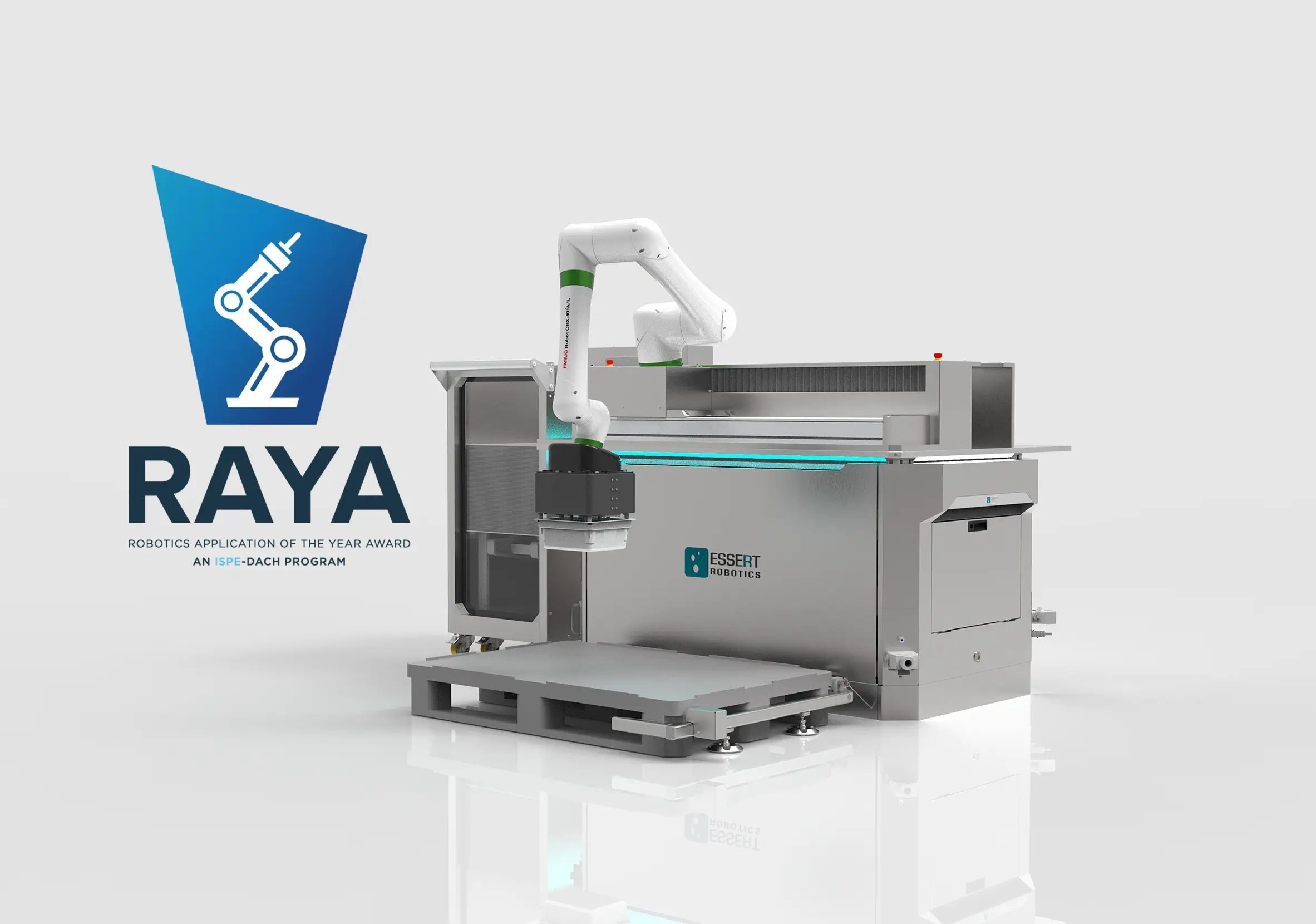
The RoboTub system represents a convergence of technological advances that provide practical, cost-effective alternatives to manual operations. This solution leverages collaborative robotics, computer vision, and intelligent control specifically designed for pharmaceutical applications.
Key technological advantages:
Vision-Based Recognition: A camera locates every tub on the pallet and checks its position and orientation before the robot picks it.
Collaborative Robotics: Sophisticated force and motion sensing enables safe interaction with human workers while maintaining gentle product handling. The system detects unexpected contact and immediately adjusts behavior to prevent injury or damage.
Modular Architecture: Two configurations, RoboTub with 3 tubs per minute and RoboTub Pro with 6, both including pallet exchange, let facilities match capacity to their line. This modularity enables incremental implementation strategies that reduce financial risk.
Integrated Buffering: Intelligent systems accommodate temporary imbalances between supply and demand, ensuring continuous operation despite timing variations in manual processes.
What It Delivered at Vetter
At Vetter Pharma, RoboTub runs in production. Arno Schroff, Director Site and Plant Development: “one single RoboTub module can reduce the number of operators down to 1. The system has already paid for itself after 1 year.” Each RoboTub is specified for at least 98% technical availability.
The validation process addresses pharmaceutical requirements through comprehensive testing and documentation across all operating conditions. Change management strategies emphasize how automation eliminates hazardous tasks while creating opportunities for higher-value activities.
Training programs ensure operators can effectively interact with automated systems while maintaining intervention capabilities when necessary. This collaborative approach helps workers understand how their expertise complements rather than competes with automated capabilities.
Measuring Success: Key Performance Indicators
Evaluating automated handling system performance requires balancing traditional efficiency measures with pharmaceutical industry requirements encompassing quality, safety, compliance, and operational flexibility.
Critical success metrics include:
Safety Performance: Injury frequency rates, workers’ compensation costs, near-miss incidents, and ergonomic risk assessments demonstrate automation’s impact on worker welfare and organizational sustainability.
Productivity Measures: Direct throughput improvements, system availability, cycle time consistency, and enhanced line balance capture both immediate and broader efficiency gains.
Quality Indicators: Container damage rates, contamination incidents, handling-related deviations, and customer complaints show that automation maintains or improves product quality.
Financial Performance: Direct labor savings, reduced compensation expenses, improved asset utilization, and enhanced delivery reliability provide comprehensive economic validation.
Compliance Metrics: Audit findings, deviation rates, and documentation completeness demonstrate regulatory support while capturing data integrity improvements from automated collection.
The Future of Pharmaceutical Handling
Automated handling systems represent part of a broader transformation toward intelligent manufacturing environments leveraging advanced technologies to optimize production operations. As AI, machine learning, and sensor technologies mature, capabilities will expand significantly beyond current applications.
Emerging capabilities include:
Predictive maintenance using machine learning to prevent failures
Advanced vision systems providing comprehensive quality assessment
AI-driven optimization enabling self-improving performance
Expanded modularity for highly customized automation solutions
Seamless integration with manufacturing execution systems
The convergence of automated handling with other technologies will create synergistic benefits exceeding individual system capabilities. Integration with automated guided vehicles, robotic assembly, and intelligent packaging will enable fully automated material flow from raw materials through finished products.
Conclusion: The Time for Action is Now
The transformation through automated tub and vial handling is a shift toward manufacturing environments that put human welfare and operational excellence first. As regulatory requirements intensify and competitive pressures grow, eliminating manual handling bottlenecks becomes essential for maintaining competitiveness.
The evidence supporting automation is compelling across multiple performance dimensions. Safety improvements alone justify investments, because manual handling is one of the main sources of musculoskeletal strain on the line. Combined with productivity improvements, quality enhancements, and operational flexibility benefits, automated systems deliver comprehensive value extending far beyond labor cost reduction.
Success stories from leading companies demonstrate that technology has matured to minimize implementation risks while delivering substantial, immediate benefits. Early adopters establish competitive advantages that become increasingly difficult to match as automation becomes widespread.
The question is not whether automated handling will become standard, but whether individual companies will lead or follow this inevitable transformation.
The pharmaceutical industry has undergone a remarkable transformation. State-of-the-art filling machines operate with precision measured in microliters. Inspection systems detect defects invisible to the human eye. Yet in most facilities, there remains one persistent bottleneck: the manual handling of tubs and vials.
This seemingly minor aspect carries hidden costs that extend far beyond obvious inefficiencies. The repetitive lifting and positioning of containers represents not just a productivity challenge, but a significant health and safety risk affecting both human welfare and business performance.
According to the US Bureau of Labor Statistics, musculoskeletal disorders account for roughly a third of all worker injuries involving days away from work, and the National Academies have estimated their cost to US employers at up to $54 billion a year.
The True Cost of Manual Handling
The economic impact of manual tub and vial handling extends far beyond visible labor costs. While managers can calculate hourly wages, the comprehensive impact encompasses a complex web of hidden expenses.
Direct costs include:
Medical treatment and workers’ compensation claims
Specialized cleanroom rehabilitation requirements
Higher insurance premiums for facilities with poor safety records
Indirect costs often dwarf direct expenses:
Production disruptions when experienced operators are absent
Extensive training requirements for replacement personnel
Lost productivity from operator fatigue and reduced pace
Opportunity cost of deploying skilled technicians for manual tasks
The pharmaceutical industry’s emphasis on validated processes means temporary workers cannot simply replace experienced operators. New personnel require extensive training in GMP protocols, cleanroom procedures, and equipment operation before contributing meaningfully to production.
When skilled pharmaceutical technicians spend time on repetitive lifting, organizations forfeit the potential benefits of their expertise in process optimization, quality assurance, and continuous improvement initiatives.
Health Impact: More Than Just Numbers
Understanding the physiological impact requires examining both immediate biomechanical stresses and cumulative effects. A single tub looks manageable. The load comes from repetition: operators may handle hundreds of tubs in a single shift, creating cumulative loading that exceeds safe limits.
Cleanroom requirements create unique challenges. Gowning protocols often necessitate awkward postures, and contamination prevention means operators cannot always position themselves optimally for lifting. The precision required when placing tubs increases muscle tension and extends lifting cycle duration.
Key health concerns include:
Spinal loading from repeated lifting, twisting and reaching
Upper extremity disorders from sustained grip strength requirements
Fatigue accumulation increasing injury risk throughout shifts
Psychological stress from chronic pain affecting cognitive performance
The RoboTub Solution: Technology Meets Safety
The RoboTub system represents a convergence of technological advances that provide practical, cost-effective alternatives to manual operations. This solution leverages collaborative robotics, computer vision, and intelligent control specifically designed for pharmaceutical applications.
Key technological advantages:
Vision-Based Recognition: A camera locates every tub on the pallet and checks its position and orientation before the robot picks it.
Collaborative Robotics: Sophisticated force and motion sensing enables safe interaction with human workers while maintaining gentle product handling. The system detects unexpected contact and immediately adjusts behavior to prevent injury or damage.
Modular Architecture: Two configurations, RoboTub with 3 tubs per minute and RoboTub Pro with 6, both including pallet exchange, let facilities match capacity to their line. This modularity enables incremental implementation strategies that reduce financial risk.
Integrated Buffering: Intelligent systems accommodate temporary imbalances between supply and demand, ensuring continuous operation despite timing variations in manual processes.
What It Delivered at Vetter
At Vetter Pharma, RoboTub runs in production. Arno Schroff, Director Site and Plant Development: “one single RoboTub module can reduce the number of operators down to 1. The system has already paid for itself after 1 year.” Each RoboTub is specified for at least 98% technical availability.
The validation process addresses pharmaceutical requirements through comprehensive testing and documentation across all operating conditions. Change management strategies emphasize how automation eliminates hazardous tasks while creating opportunities for higher-value activities.
Training programs ensure operators can effectively interact with automated systems while maintaining intervention capabilities when necessary. This collaborative approach helps workers understand how their expertise complements rather than competes with automated capabilities.
Measuring Success: Key Performance Indicators
Evaluating automated handling system performance requires balancing traditional efficiency measures with pharmaceutical industry requirements encompassing quality, safety, compliance, and operational flexibility.
Critical success metrics include:
Safety Performance: Injury frequency rates, workers’ compensation costs, near-miss incidents, and ergonomic risk assessments demonstrate automation’s impact on worker welfare and organizational sustainability.
Productivity Measures: Direct throughput improvements, system availability, cycle time consistency, and enhanced line balance capture both immediate and broader efficiency gains.
Quality Indicators: Container damage rates, contamination incidents, handling-related deviations, and customer complaints show that automation maintains or improves product quality.
Financial Performance: Direct labor savings, reduced compensation expenses, improved asset utilization, and enhanced delivery reliability provide comprehensive economic validation.
Compliance Metrics: Audit findings, deviation rates, and documentation completeness demonstrate regulatory support while capturing data integrity improvements from automated collection.
The Future of Pharmaceutical Handling
Automated handling systems represent part of a broader transformation toward intelligent manufacturing environments leveraging advanced technologies to optimize production operations. As AI, machine learning, and sensor technologies mature, capabilities will expand significantly beyond current applications.
Emerging capabilities include:
Predictive maintenance using machine learning to prevent failures
Advanced vision systems providing comprehensive quality assessment
AI-driven optimization enabling self-improving performance
Expanded modularity for highly customized automation solutions
Seamless integration with manufacturing execution systems
The convergence of automated handling with other technologies will create synergistic benefits exceeding individual system capabilities. Integration with automated guided vehicles, robotic assembly, and intelligent packaging will enable fully automated material flow from raw materials through finished products.
Conclusion: The Time for Action is Now
The transformation through automated tub and vial handling is a shift toward manufacturing environments that put human welfare and operational excellence first. As regulatory requirements intensify and competitive pressures grow, eliminating manual handling bottlenecks becomes essential for maintaining competitiveness.
The evidence supporting automation is compelling across multiple performance dimensions. Safety improvements alone justify investments, because manual handling is one of the main sources of musculoskeletal strain on the line. Combined with productivity improvements, quality enhancements, and operational flexibility benefits, automated systems deliver comprehensive value extending far beyond labor cost reduction.
Success stories from leading companies demonstrate that technology has matured to minimize implementation risks while delivering substantial, immediate benefits. Early adopters establish competitive advantages that become increasingly difficult to match as automation becomes widespread.
The question is not whether automated handling will become standard, but whether individual companies will lead or follow this inevitable transformation.
WRITTEN BY
Ayhan Akyüz
Head of Marketing & Communications
INSIGHTS
Keep reading.
CHANGE
Humanoid Robots in Pharma Manufacturing: What Is Hype, What Is Real
Read
EFFICIENCY
What Is Robotic Tub Handling in Pharma Fill and Finish?
Read

CHANGE
What Is High-Mix Low-Volume (HMLV) Manufacturing in Pharma and MedTech?
Read

NEWS
Two Specialists. One Inspection Platform. ALVA Is Here.
Read
NEWSLETTER
What changed in pharma and MedTech automation.
Subscribe
INSIGHTS
Keep reading.
CHANGE
Humanoid Robots in Pharma Manufacturing: What Is Hype, What Is Real
Read
EFFICIENCY
What Is Robotic Tub Handling in Pharma Fill and Finish?
Read
CHANGE
What Is High-Mix Low-Volume (HMLV) Manufacturing in Pharma and MedTech?
Read
NEWS
Two Specialists. One Inspection Platform. ALVA Is Here.
Read
NEWSLETTER
What changed in pharma and MedTech automation.
Subscribe
